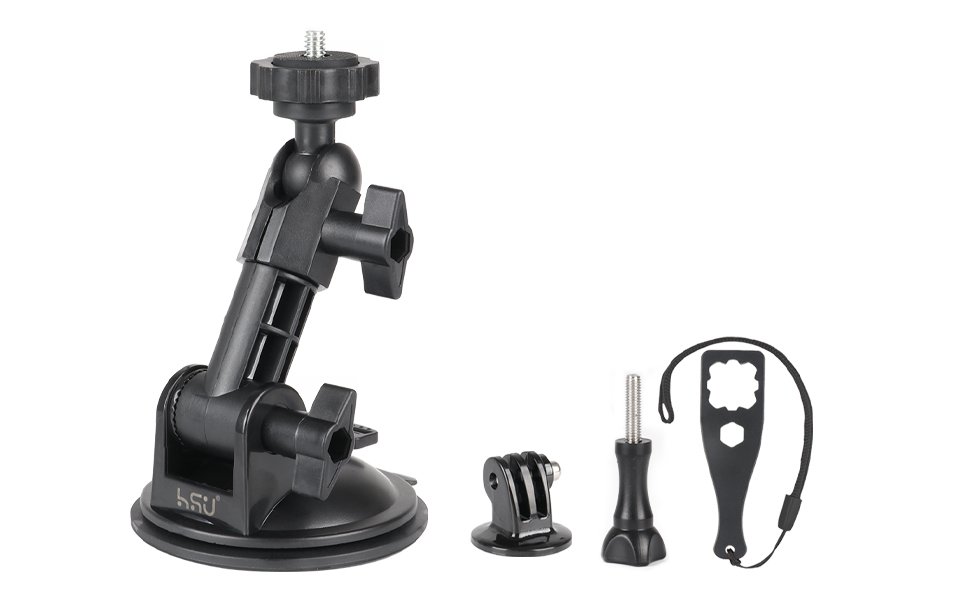
Some of the most watched POV footage online — the hood-mounted road trip clip, the boat-window wake shot, the windshield timelapse of a storm rolling in — comes from one of the simplest accessories in the entire action camera category: a suction cup mount. It has no batteries, no moving electronics, and no complicated setup. It just needs to hold securely and let you angle the camera exactly where you want it.
At HSU we design and test mounting hardware for GoPro, Insta360, and Osmo Action systems, and the suction cup mount is one of the products we get the most practical questions about — mainly because people assume “suction cup” means one simple design, when in practice grip strength, adjustability, and surface compatibility vary a lot between products. This article walks through how a suction cup mount actually works, where it performs best, and what to look for, using our own <a href=”https://hsuglobal.com/product/hsu-heavy-duty-suction-cup-mount-for-action-cameras-gopro-insta360-osmo-action-compatible-easy-install-360-rotation-nano-adhesive-pad/”>Heavy-Duty Suction Cup Mount</a> as a reference point for what a well-built version of this accessory should include.
How a Suction Cup Mount Actually Works
A suction cup mount holds itself in place through vacuum pressure between the cup and the surface, reinforced in better designs by an adhesive layer around the rim. Two things determine whether it holds securely:
- Surface quality. Suction seals form properly on smooth, non-porous surfaces — glass, painted metal, smooth plastic. Textured, matte, or porous surfaces (unfinished wood, fabric, rough plastic) won’t create a reliable seal no matter how good the mount is.
- Reinforced adhesion. A silicone suction cup alone can lose grip over time, especially with vibration or temperature changes. A nano self-adhesive ring around the base of the suction cup — like the one on the HSU Heavy-Duty Suction Cup Mount — adds a second layer of hold on top of the vacuum seal, without leaving residue or damaging the surface when removed, since it’s washable and reusable rather than a one-time adhesive.
This combination is what makes a suction mount viable for a moving vehicle or boat, rather than just a static surface — the adhesive layer compensates for the vibration and airflow that would otherwise gradually work a suction-only cup loose.
Where a Suction Cup Mount Is the Right Tool
Suction mounts solve a specific problem: getting a stable, adjustable POV angle from a hard, smooth surface without drilling, clamping, or leaving permanent hardware behind.
Common use cases:
- Windshield or dashboard mounting for road trip footage, dash-cam-style recording, or reaction shots from inside the vehicle
- Car exterior mounting (hood, roof, trunk) for the classic “camera on the car” driving shot — this is where the reinforced adhesive layer matters most, since exterior mounts face wind resistance at speed
- Boat windows and hulls for on-water footage where clamp-style mounts don’t have anything to clamp onto
- Any smooth indoor surface — glass, tile, painted walls — for fixed-angle studio or product shots
Where it’s not the right choice: suction mounts are not built for high-impact sports like surfing or snowboarding, since sudden shocks can break the seal in a way that gradual vibration usually doesn’t. For those activities, a strap, clamp, or body mount is the more appropriate accessory — a suction cup’s strength comes from a sustained, even seal, not sudden-impact resistance.
What to Check Before Buying One
- Ball head adjustability. A 360° ball head lets you angle the camera in any direction after the mount is already stuck in place — important because you often can’t reposition the whole mount once it’s sealed without breaking the suction. A mount that also has a rotating extended arm (180° on the HSU version) gives you an additional axis of adjustment separate from the ball head itself, useful for reaching angles a ball head alone can’t cover.
- Camera compatibility. Confirm the mount uses the standard action-camera mount interface and lists your specific camera generation — the HSU Heavy-Duty Suction Cup Mount is built for GoPro Hero 3 through Hero 13, Osmo Action 3/4/5, and Insta360 cameras, which covers most current and recent-generation action cameras without needing a separate adapter.
- Reusability of the adhesive. A one-time adhesive pad loses effectiveness after removal. A washable, repeatable nano-adhesive pad can be cleaned and reused across multiple mounting sessions without leaving residue — worth checking specifically if you plan to move the mount between vehicles or locations often.
- Size and weight for your camera. A compact, lightweight mount (the HSU version weighs roughly 0.2 kg) reduces wind resistance and strain on the suction seal at speed, compared to bulkier mounting systems designed for heavier standalone cameras.
How to Get a Secure Mount, Step by Step
- Clean the surface first. Dust, road grime, or condensation on glass or paint will weaken the vacuum seal significantly — wipe the surface dry before attaching.
- Press the cup flat, then lock the lever/thumbscrew. Push evenly across the entire cup surface to force out air, then engage the locking mechanism fully.
- Test the hold before attaching your camera. Give the mount a firm tug in the direction of expected force (forward for a hood mount, downward for a windshield mount) before trusting it with your camera.
- Adjust the ball head and arm to your framing, then re-tighten. Set your angle after the mount is secured, not before — repositioning after tightening can loosen the seal slightly.
- Re-check periodically on longer drives. For extended trips, a quick check at a rest stop is worth the ten seconds it takes, especially in hot weather where suction can weaken slightly as temperatures rise.
Frequently Asked Questions
Will a suction cup mount damage my car’s paint or windshield? A properly designed mount with a silicone suction cup and washable adhesive pad shouldn’t damage paint or glass when removed correctly — the reinforced adhesive on a mount like the HSU Heavy-Duty Suction Cup Mount is specifically designed to be residue-free and non-damaging on removal, unlike permanent double-sided tape.
How much weight can a suction cup mount actually hold? This varies by product, but action camera suction mounts are generally built for the weight of the camera itself (typically under 200g), not heavier accessory rigs or cages. Adding significant extra weight — large external microphones, big battery packs — increases the load on the seal and raises the risk of it loosening at speed.
Can I use a suction cup mount on a motorcycle or bike? Suction mounts can work on smooth motorcycle bodywork, but they’re not ideal for handlebars (which are usually textured or curved in a way that doesn’t seal well) or for high-vibration off-road use. A dedicated clamp-style handlebar mount is generally the better choice for two-wheeled vehicles.
Does cold or hot weather affect how well it holds? Yes, to some degree. Extreme heat can slightly soften adhesive and reduce grip over long periods; extreme cold can make the silicone cup less pliable when first applied. Checking the mount periodically during long trips in extreme conditions is a reasonable precaution either way.
Final Thoughts
A suction cup mount is one of the simplest accessories in an action camera kit, but “simple” doesn’t mean “interchangeable” — grip strength, adjustability, and surface compatibility vary meaningfully between products, and those differences show up exactly when you need the mount most: at highway speed, in changing weather, on a surface you can’t easily double-check mid-drive. A 360° ball head, a secondary rotating arm, and a reinforced, reusable adhesive layer are the three details worth checking regardless of which specific mount you end up choosing.
About the author: This guide is written and maintained by HSU’s product team, who design and test mounting hardware for GoPro, Insta360, and Osmo Action camera systems. Compatibility and durability notes are based on hands-on product testing and are updated as camera generations and mounting standards evolve.