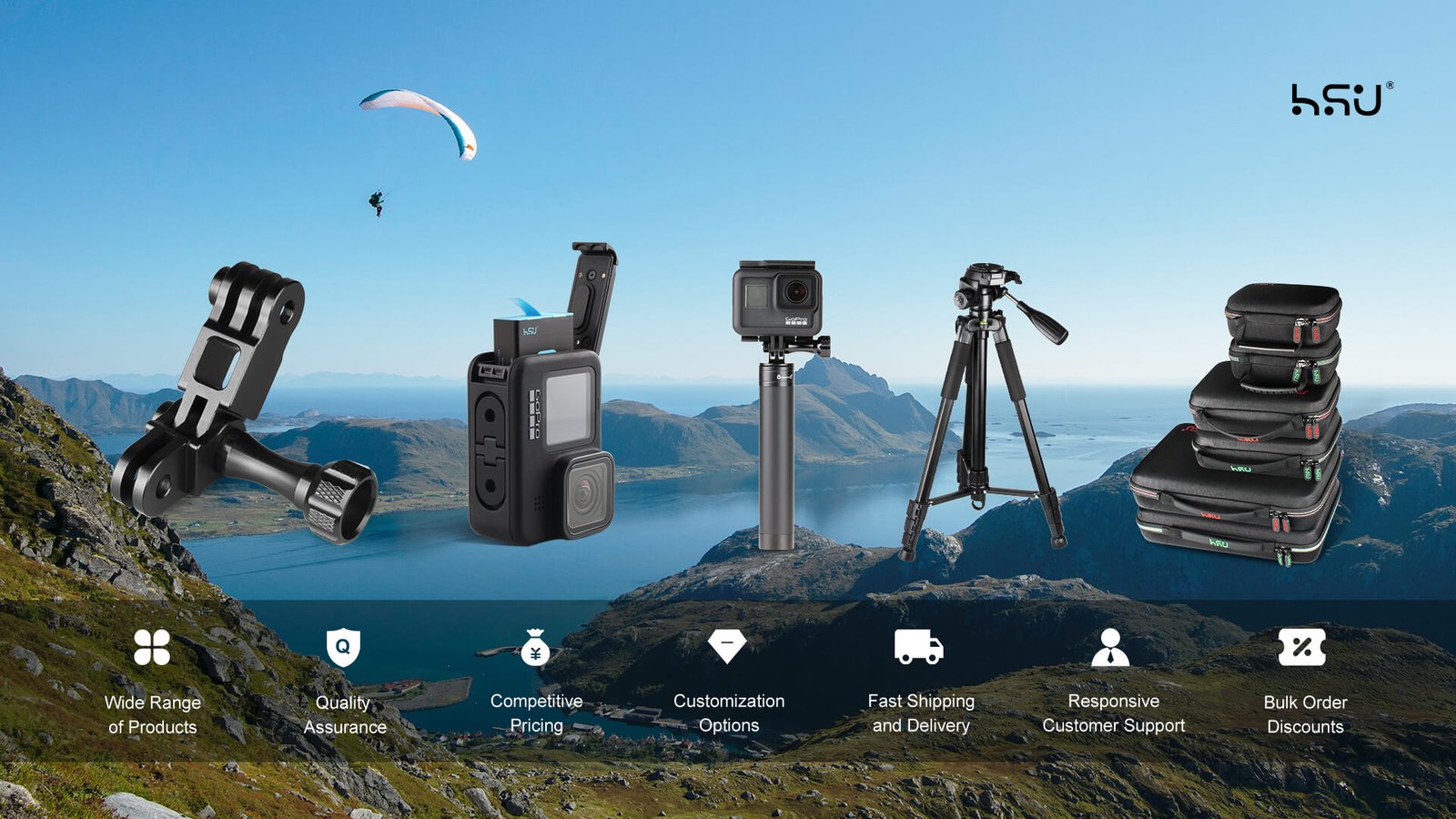
Buy an action camera and open an accessories page for the first time, and it’s easy to feel a little lost — mounts, grips, extension poles, waterproof housings, batteries, carrying cases. The category list alone can be overwhelming, and it’s not always obvious which ones you actually need.
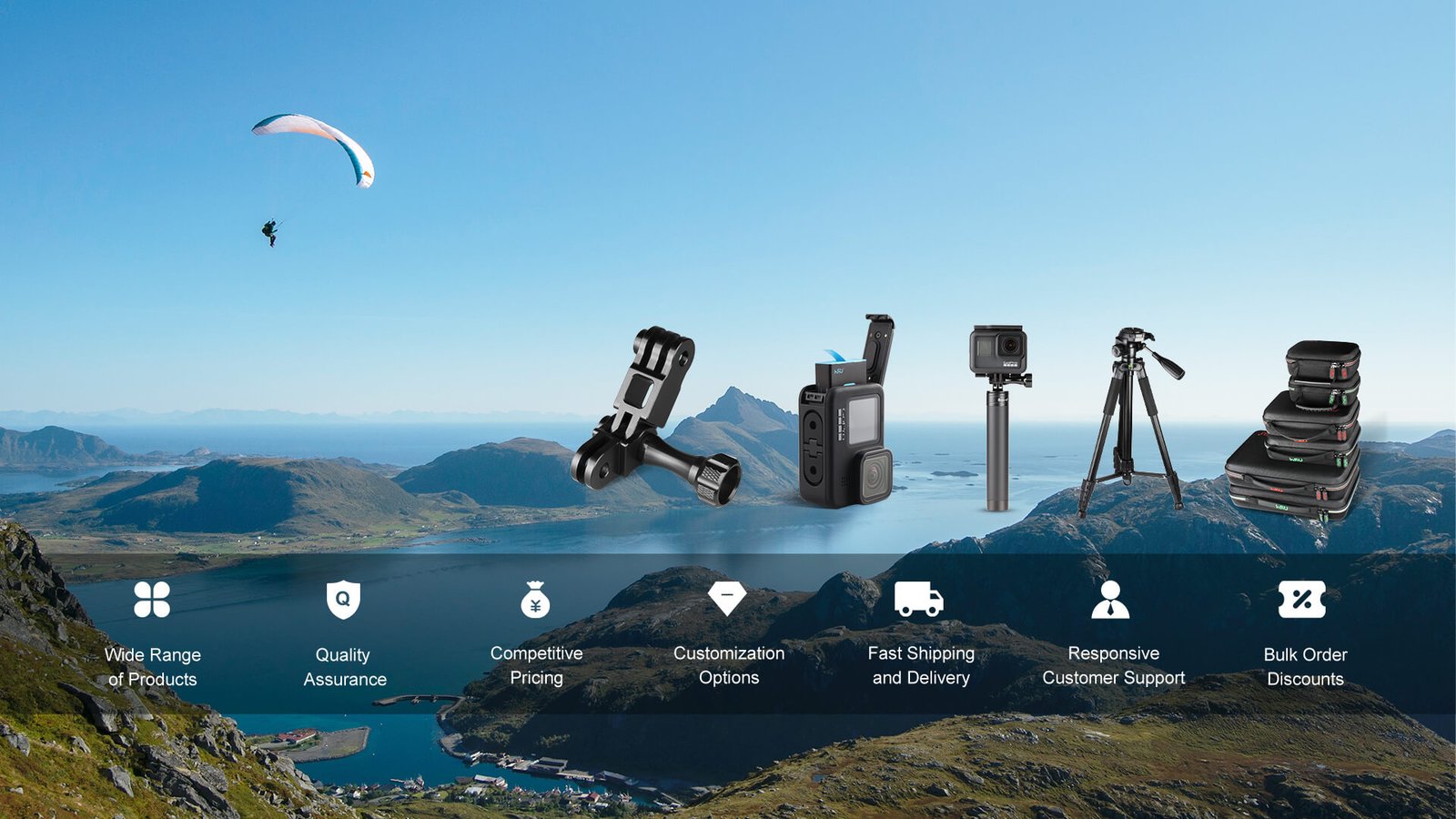
At HSU, we spend a lot of time designing and testing accessories for action cameras, phones, and drones, and the most common question we hear isn’t “which brand is best” — it’s “what does this thing actually do, and do I need it.” This guide skips product recommendations and instead breaks accessories down by the problem each category solves. Understanding the logic behind each type makes it much easier to decide what you actually need, regardless of which brand you end up buying.
What This Guide Covers
We’ve grouped camera accessories into six categories, based on the problem each one solves:
- How do I attach the camera to something? → Mounts & mounting hardware
- How do I get the camera farther from me? → Extension poles & selfie sticks
- How do I keep the footage steady? → Grips & stabilization
- How do I protect it from damage or water? → Cases & protective housing
- How do I keep it running all day? → Batteries & charging accessories
- How do I improve image quality? → Lenses & filters
Understood in this order, it becomes clear that the first four categories cover the basics almost every user needs. The last two are situational — worth adding once you know your specific shooting needs (extended sessions, image quality goals) rather than defaults for everyone.
1. Mounts & Mounting Hardware: Solving the “Attachment” Problem
The core job of a mount is simple: hold the camera steady on something, so you don’t have to hold it in your hand.
Common types and how they work:
- Suction mounts rely on vacuum suction to grip smooth, curved surfaces (car bodies, boat hulls, smooth helmet shells) — useful for vehicle-mounted shots. The smoother and more curved the surface, the stronger the seal; porous or textured surfaces won’t hold a suction mount reliably.
- Handlebar/clamp mounts use a clamp or screw mechanism to grip a tube-shaped surface (bike handlebars, motorcycle bars). Useful for cycling and riding footage, but sustained vibration over time can loosen the screws, so periodic checks are worth doing.
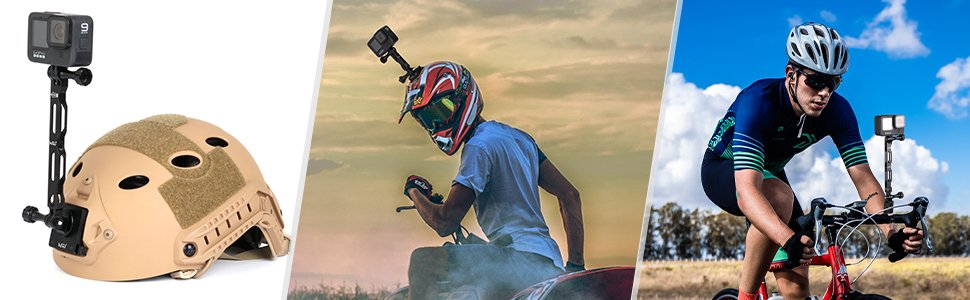
- Chest or head straps attach the camera to your body for first-person POV shots — hiking, running, diving. Chest mounts tend to be more stable, though the framing shifts slightly with breathing; head mounts more closely match “what you’re actually looking at,” but are less stable at higher speeds.
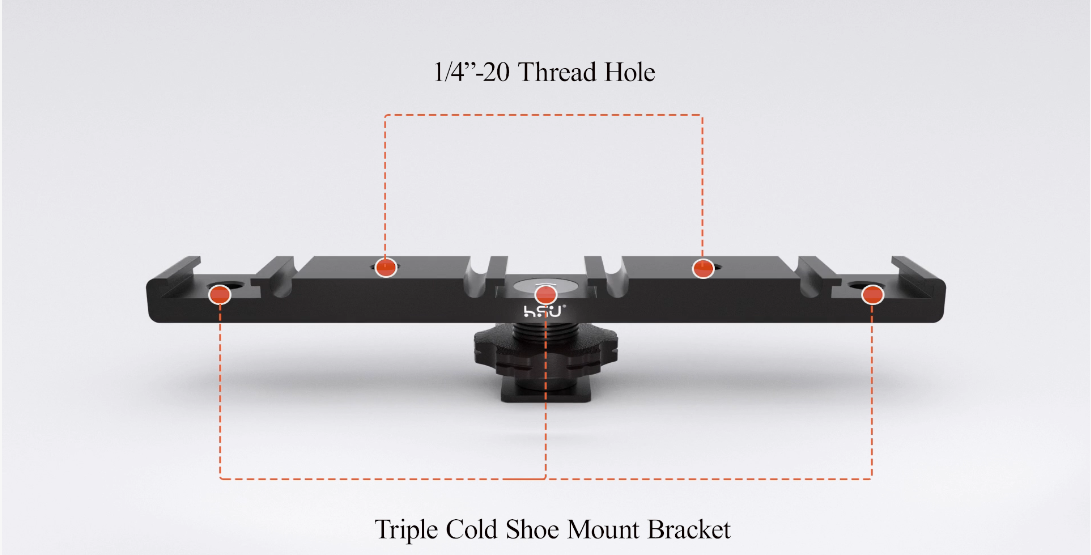
- Ball-joint or articulating mounts let you adjust the camera’s angle after it’s already attached, offering more flexibility than a fixed-angle mount — useful when you need to reframe often without repositioning the whole mount.
Once you understand these mechanics, choosing a mount stops being about price and starts being about matching the mount type to the surface or body part you’re actually attaching it to.
2. Extension Poles & Selfie Sticks: Solving the “Distance” Problem
An extension pole (or selfie stick) solves a simple framing problem: the camera is too close to you to capture the shot you want.
- How it works: an extendable shaft pushes the camera farther away, widening the field of view — useful for solo shots, underwater footage, or anything where you need to show more of the surrounding environment than a handheld shot would capture.
- Floating selfie sticks are built with buoyant material inside, so they don’t sink if dropped in water — designed specifically for water sports, which matters a lot more once you’re in open or deep water rather than a shallow pool.
- Shaft material affects handling. Aluminum shafts are sturdier and more durable but heavier; carbon fiber is lighter and easier to hold for long stretches, but usually costs more.
- The rotating head design matters. A well-built selfie stick usually has an independent rotation mechanism at the head — built from bearings and spring tension internally — that lets you adjust the camera’s angle without repositioning the whole shaft. Whether that rotation is smooth and full-range (ideally close to 360°) is a practical way to judge build quality.
3. Grips & Stabilization: Solving the “Shaky Footage” Problem
Even with built-in camera stabilization, hand shake while filming is still one of the most common quality issues.
- What a grip actually does. It’s not just about comfort — a well-designed grip often includes weight balance and hand positioning that reduces how much natural hand tremor transfers to the camera.
- Tripods vs. monopods. A tripod provides fully static support, ideal for fixed shots (timelapses, interview-style footage). A monopod trades some stability for mobility, useful when you want some support but still need to move around while shooting.
- Gimbals/stabilizers use motors to actively counteract movement, offering stronger stabilization than passive mechanical designs — but they add weight and cost. These make more sense for someone who’s already shooting handheld footage and finding it too shaky, rather than a default purchase for everyone.
4. Cases & Protective Housing: Solving the “Damage and Water” Problem
This category is easy to underestimate, but it’s the most direct way to protect the investment you’ve already made in the camera itself.
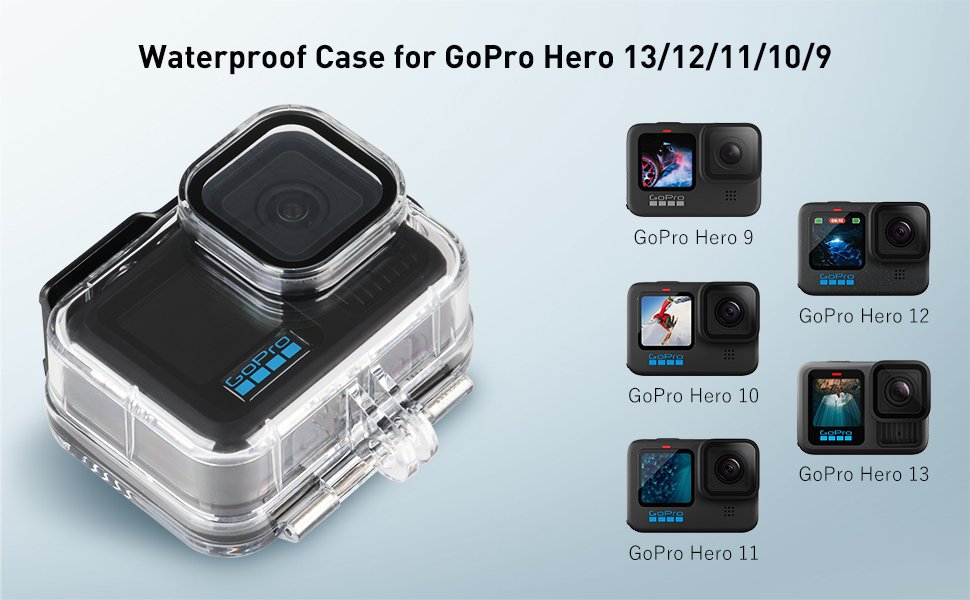
- “Waterproof” isn’t one fixed standard — it’s a depth rating. A camera’s built-in waterproofing (often around 5–10 meters) is fine for swimming or light splashing. Diving to greater depths requires a housing specifically rated for that depth — the word “waterproof” alone doesn’t tell you how deep is actually safe.
- Impact protection and water protection are two separate jobs. A silicone sleeve mainly guards against scratches and light bumps, but usually isn’t fully submersible. A hard housing protects against both impact and water, but adds bulk and can slightly affect touchscreen access or audio pickup.
- Carrying cases solve a transport problem, not a shooting problem. A padded hard-shell case protects your camera, mounts, batteries, and cables while they’re in a backpack or suitcase — a different job from the protective housing you use while actually shooting, and one that’s easy to conflate with it.
- Lens protectors are cheap insurance. A scratched or sand-pitted protector is far cheaper to replace than the camera’s actual lens, which matters especially in beach, desert, or snow conditions where fine particles constantly contact the lens.
5. Batteries & Charging Accessories: Solving the “Runtime” Problem
Battery anxiety is close to universal among action camera users, especially for high-drain scenarios like timelapses or 4K video.
- Spare batteries vs. fast charging. Rather than counting on one battery charging quickly enough between uses, carrying several spares and rotating them is the most direct, reliable way to extend a full day of shooting.
- Dual or triple-bay chargers let you charge multiple batteries at once, far more efficient than charging them one at a time through the camera’s own port — better suited to an all-day shooting pace.
- Cold weather noticeably reduces battery capacity. This is a physical property of lithium batteries, not a product defect. In snow or high-altitude conditions, keeping spares in an inner jacket pocket close to your body meaningfully improves real-world runtime.
- Battery packs with an external battery bay provide continuous power without interrupting recording — useful for extended fixed-position shoots, but always worth confirming compatibility with your specific camera model and firmware first.
6. Lenses & Filters: Solving the “Image Quality” Problem
This category is more advanced and optional — worth considering once your basic accessories are already covered and you want to push image quality further.
- Wide-angle or macro add-on lenses change the camera’s field of view or focus distance, offering a creative effect, but can introduce distortion — a nice-to-have rather than a necessity.
- Polarizing filters (CPL) reduce glare off water and reflective surfaces, and are especially useful for water sports or diving footage where glare is a common problem — one of the more practically useful filter types.
- Neutral density (ND) filters reduce the light entering the lens, letting you use slower shutter speeds even in bright daylight — this is what creates smooth water and cloud motion in footage. Lower priority for casual everyday shooting, more relevant for anyone specifically chasing that cinematic look.
Matching Accessories to Your Actual Use Case
A practical way to decide what you need: start from your primary shooting scenario, then work backward to the accessory types that support it.
- Mainly cycling/motorcycling: handlebar mount, vibration-resistant materials, lens protector
- Mainly diving/water sports: depth-rated housing, floating selfie stick, spare batteries
- Mainly hiking/running vlogs: chest or head mount, extension pole, monopod
- Mainly timelapse/fixed-position content: tripod, spare batteries or external battery bay, dual-bay charger
- General travel/everyday use: hard-shell carrying case, dual-bay charger, universal mount adapter
Frequently Asked Questions
Does having more accessories automatically mean better footage?
Not really. Most of the improvement in shooting experience and quality comes from whether your basic accessories match your actual shooting scenario — not from how many accessories you own. It’s usually more effective to start with the high-frequency basics (a mount and spare batteries) and add more only when you run into a specific, recurring problem.
What’s the real difference between third-party and official accessories?
The main difference is how rigorously compatibility has been verified, not that third-party is inherently worse. When choosing a third-party accessory, check that it’s explicitly documented as compatible with your specific camera model and current firmware — that matters more than brand name or price alone.
Should I trust my camera’s built-in waterproofing, or do I need a separate case?
It depends on the depth you’re actually shooting at. Built-in waterproofing is usually fine for swimming or light splashing; if you’re diving to greater depths, always check the specific depth rating on a dedicated housing rather than assuming “waterproof” covers any depth.
Is a rotating mount worth it over a fixed-angle one?
If you regularly need to adjust framing from the same fixed position (like a vehicle or boat mount mid-shoot), the convenience difference is significant. If you typically set your angle once before shooting and rarely adjust mid-session, a fixed-angle mount works fine and usually costs less.
Final Thoughts
Camera accessories can look overwhelming as a category, but broken down individually, each type solves one specific problem: mounts handle attachment, extension poles handle framing distance, grips and stabilizers handle shake, protective housing handles safety, batteries handle runtime, and lenses/filters handle image quality. Once that logic clicks, choosing accessories stops being about following trends and becomes about matching your actual shooting scenario to the right category — which is usually a more efficient approach than just browsing a bestseller list.
About the author: This guide is written and maintained by HSU’s product team, who design and test mounts, grips, batteries, and protective accessories for action cameras, phones, and drones. Content is based on hands-on product development and testing experience, and is updated as camera technology and accessory standards evolve.